
If you lose your job in Germany, you will probably hear the word Abfindung very quickly. It means severance pay. Many expats assume it is a legal right, as it is in some other countries. In Germany, it usually is not. Yet many employees who are dismissed do receive a payment.
The reason is simple. A dismissal that does not hold up in court is expensive for the employer. Paying severance is often the cheaper way out. How much you get therefore depends less on a fixed rule and more on how strong your position is.
When You Have a Legal Right to Severance
In most cases, German law does not oblige your employer to pay severance. A legal claim only exists in a few specific situations:
- Dismissal with a severance offer. If your employer dismisses you for operational reasons and states in the letter that you receive severance under Section 1a if you let the deadline pass, you receive half a monthly salary per year of service. If the employer offers a different amount, it is an individual offer, not a claim under Section 1a. The condition is that you do not challenge the dismissal within three weeks (Section 1a, Dismissal Protection Act).
- Social plan. In larger restructurings, the works council and employer often agree a social plan (Sozialplan) with fixed severance amounts.
- Collective agreement. Some collective agreements (Tarifverträge) provide for severance when jobs are cut.
- Court decision. If continuing the employment is unreasonable, the labour court can end it and award severance. The cap is twelve monthly salaries, or up to eighteen for older employees with long service (Sections 9 and 10, Dismissal Protection Act).
In all other cases, severance is the result of a negotiation. That is the normal case.
Why Employers Pay Anyway
The key is the Dismissal Protection Act (Kündigungsschutzgesetz). It applies if you have worked for the company for more than six months and it employs more than ten people. Part-time staff count pro rata.
Under this law, your employer needs a valid reason to dismiss you. The reason must relate to your conduct, your person or the company's operations. The bar is high, and many dismissals fail in court.
If a dismissal fails, the employer must take you back and pay your salary for the whole time the case took, minus unemployment benefit and other earnings. This is called Annahmeverzugslohn, or back pay. A court case can take months. The financial risk for the employer grows every week.
Severance is the price your employer pays to avoid this risk. The more likely it is that the dismissal would fail, the higher the price.
Calculate Your Severance Pay
See a realistic range for your severance in under a minute. No sign-up, no contact details.
- Based on your salary and years of service
- Shows the usual range from 0.5 to 1.0
- Explains what strengthens your position
How Severance Pay Is Calculated
The common rule of thumb is:
Half a gross monthly salary × years of service
Courts use this formula when they propose a settlement, and most negotiations start from it. A few details matter:
- Monthly salary means your gross pay including regular allowances. Annual bonuses or a 13th salary are often added pro rata.
- Years of service count from your first day with the employer. A remaining period of more than six months is rounded up to a full year.
- The factor of 0.5 is only a starting point. Factors between 0.5 and 1.0 are common. In strong cases, they can be higher. In a termination agreement, a factor above 0.5 can increase the risk of a blocking period, because the employment agency then checks whether the dismissal would really have been lawful. A court settlement avoids this.
| Example | Salary | Years | Factor 0.5 | Factor 1.0 |
|---|---|---|---|---|
| Junior employee | €3,500 | 3 | €5,250 | €10,500 |
| Experienced specialist | €5,500 | 7 | €19,250 | €38,500 |
| Senior manager | €9,000 | 12 | €54,000 | €108,000 |
You can work out your own range with our severance pay calculator.
What Increases Your Severance
The factor depends on how strong your position is. These points usually push it up:
- Weak reasons for the dismissal. Formal mistakes, a missing warning or a flawed social selection all weaken the employer's case.
- Special protection. Pregnancy, parental leave, severe disability or works council membership make a dismissal much harder.
- Long service and older age. Courts take both into account, and so do employers in negotiations.
- Time pressure on the employer. If the company wants a quick and quiet solution, for example in a restructuring, it often pays more.
- A filed claim. Once you have filed a claim at the labour court, the employer's risk becomes real. Many settlements are reached at the first court hearing.
The Three-Week Deadline
This is the single most important rule. You have three weeks from the day you receive the dismissal letter to file a claim at the labour court (Arbeitsgericht). The deadline is in Section 4 of the Dismissal Protection Act.
If you miss it, the dismissal is generally treated as valid, even if it was clearly flawed. Your leverage for negotiating severance is then largely gone.
Received a dismissal letter? The three weeks start on the day it reaches you, not on your last working day.
Get Your Free Case Review →The letter counts as received when it reaches your letterbox and you could normally be expected to read it. Being on holiday does not stop the clock. If you miss the deadline through no fault of your own, you can only apply for a late claim within two weeks.
What a Claim Costs
In the first instance at the labour court, each side pays its own lawyer, even if you win. Court fees only arise if the case ends with a judgment. Legal expenses insurance with employment cover, union membership or legal aid can pay for your lawyer. In most cases that end with severance, the severance is many times the fees. See the costs of a claim.
Termination Agreements
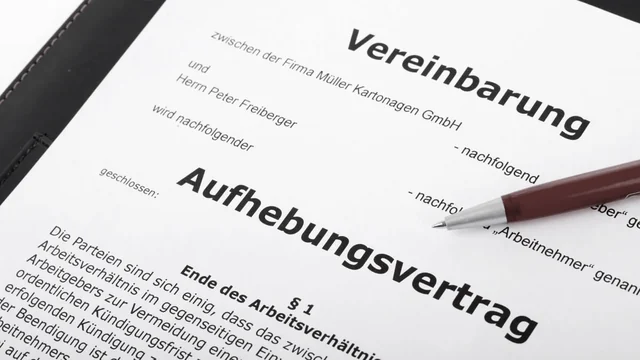
Instead of dismissing you, your employer may offer a termination agreement (Aufhebungsvertrag). You agree to end the employment, usually in return for severance.
This can be a good solution, but check it before you sign. Three points matter most:
- Unemployment benefit. Signing can trigger a blocking period (Sperrzeit) of up to twelve weeks. During this time you receive no unemployment benefit. There are exceptions: if the employer would otherwise have dismissed you for operational or personal reasons, the notice period is kept and the severance is between 0.25 and 0.5 monthly salaries per year of service, there is usually no blocking period.
- Notice period. If the agreement ends your employment earlier than your notice period would, part of the severance can delay your unemployment benefit.
- No time pressure. You do not have to sign on the spot. A serious offer will still be there after a lawyer has looked at it.
Read more in our guide to termination agreements.
How Severance Is Taxed
Severance counts as income and is subject to income tax. Genuine severance for the loss of your job is generally free of social security contributions. Amounts that are really salary, such as holiday pay or outstanding wages, are not.
Large one-off payments can push you into a higher tax bracket. The one-fifth rule (Fünftelregelung, Section 34 Income Tax Act) softens this effect. The tax office calculates the extra tax on one fifth of the payment and multiplies it by five, which has a similar effect to spreading the payment over five years.
Since January 2025, your employer deducts the full income tax first. The reduced rate under the one-fifth rule is only applied when you file your tax return. You get the difference back from the tax office, often more than a year later. The payment should also be made in one calendar year, otherwise the rule may not apply.
For details, see our guides on income tax on severance pay and the one-fifth rule.
What Expats Should Watch Out For
Most of the rules above apply to everyone. Some issues, however, are specific to international employees and are easy to miss:
- Residence permit. If your permit is tied to your job, losing it can affect your right to stay. You must inform the immigration office (Ausländerbehörde) within two weeks that the job is ending early. Check the rules for your permit early with the immigration office or a lawyer.
- Register as a jobseeker. You must register with the Federal Employment Agency (Agentur für Arbeit) within three days of learning that your job will end. If the end is more than three months away, register three months before.
- Documents in German. Dismissal letters and termination agreements are almost always in German. Do not sign anything you do not fully understand. Ask for a translation or have a lawyer explain it.
- Leaving Germany. If you plan to move abroad, the timing of the payment can affect where and how it is taxed. Get advice before you agree on a date.
What to Do Now
If you have received a dismissal or a termination agreement, take these steps:
- Write down the date you received the letter. Your three-week deadline starts on that day.
- Do not sign anything yet, and do not agree to anything in a meeting.
- Register as a jobseeker with the Federal Employment Agency.
- Collect your employment contract, recent payslips and any warnings you have received.
- Have your case reviewed by an employment lawyer before the deadline runs out.
Not sure what your case is worth? An employment lawyer can tell you in a short review, free of charge.
Get Your Free Case Review →Frequently Asked Questions
Is severance pay mandatory in Germany?
No. There is only a legal claim in a few cases, such as a social plan or a dismissal with a severance offer under Section 1a. In practice, most severance is negotiated.
How much severance is normal in Germany?
The usual starting point is half a gross monthly salary per year of service. Depending on the strength of your case, a factor of up to 1.0 or more is realistic.
Do I get severance if I resign?
Usually not. If you resign yourself, the employer has no risk to buy off. In addition, resigning can trigger a blocking period for unemployment benefit.
Do I get severance during my probation period?
Rarely. During the first six months, the Dismissal Protection Act does not apply, so the employer does not need a reason to dismiss you.