
German tax law is known for its complexity, but the basics for employees are manageable. Your employer deducts income tax from your salary each month, and in many cases you can reclaim part of it through an annual tax return.
This overview explains the key rules for expats. For individual questions, a tax adviser (Steuerberater) or an income tax assistance association is recommended.
Tax Residence
You have unlimited tax liability in Germany if you have a home available to you here or stay for more than six months, even across the turn of the year. Deregistering your address alone does not end it if you keep the flat. You are then taxed on your worldwide income, subject to double taxation agreements.
If you do not live in Germany but earn income here, for example from rental property or employment, you have limited tax liability for that German income only.
Income Tax
- Rates. In 2026, taxable income up to €12,348 is tax-free (€24,696 for joint assessment). Above that, the rate rises progressively from 14 percent to 42 percent from €69,879, and 45 percent from €277,826.
- Solidarity surcharge. 5.5 percent of the income tax, but only if the income tax exceeds €20,350 (€40,700 for joint assessment) in 2026. On investment income and corporate tax, it always applies.
- Church tax. 8 or 9 percent of the income tax if you are a member of a church that levies it. You can avoid it by leaving the church officially. When you register your address, you are asked about your religion; answer carefully, because this decides whether church tax is deducted.
- Married couples can be assessed jointly, which often reduces the total tax.
Tax Classes
Employees are assigned a tax class, which determines the monthly withholding:
| Class | For |
|---|---|
| I | single people |
| II | single parents |
| III / V | married couples with very different incomes |
| IV / IV | married couples with similar incomes |
| VI | a second job |
The tax class does not change your final income tax. Differences are settled in the tax return. But it affects net-pay-based benefits such as parental allowance, unemployment benefit and sick pay.
The Tax Return
Many employees are not obliged to file a tax return, but filing often leads to a refund, for example for work-related expenses, relocation costs or double household costs. You must file if, for example:
- you received more than €410 of unemployment benefit, parental allowance or similar benefits,
- you had foreign income in the year you moved to Germany that raises your tax rate, of more than €410,
- you are married with tax classes III and V, or use the factor method,
- you have a second job in tax class VI,
- you have more than €410 of income not taxed through payroll, such as rental income or investment income from a foreign bank.
If you received severance, filing is not mandatory for that reason alone, but it is usually the only way to get the tax relief.
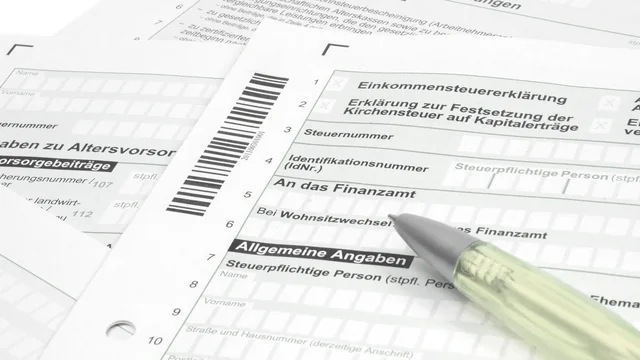
The return is filed electronically through the official ELSTER portal or tax software, including English-language software. For 2025, the deadline was 31 July 2026; with a tax adviser, it is 1 March 2027. Late filing costs at least €25 per month.
Investments
Capital income such as interest, dividends and gains on shares is taxed at a flat rate of 25 percent, plus solidarity surcharge and church tax where applicable. A savers' allowance of €1,000 (€2,000 for couples) applies. German banks deduct the tax automatically. Income from foreign banks and brokers must be declared in your tax return. For funds and ETFs, a small advance lump sum is taxed each year. Gains on crypto assets follow separate rules for private sales.
Self-Employment
Freelancers and business owners must register with the tax office and file annual income tax and usually VAT returns. Freelancers never pay trade tax. Other business owners have an allowance of €24,500, and trade tax is largely credited against their income tax. Small businesses can use the small business rule to avoid charging VAT if their turnover was no more than €25,000 in the previous year and stays below €100,000 in the current year.
E-invoicing. All businesses must be able to receive electronic invoices. From 2027, businesses with more than €800,000 turnover must issue them to other businesses, and from 2028 all businesses must, except small businesses under the small business rule.
Severance and Tax
Genuine severance for losing your job is subject to income tax but not social security contributions. Outstanding salary paid as part of it is subject to contributions. A tax relief can be claimed in the tax return. See tax on severance pay.
Leaving Germany
If you move abroad, deregister your address and inform the tax office. You will usually file a final German tax return for the year of departure. Income from German sources can remain taxable in Germany.
Exit tax. If you held at least 1 percent of a company, such as your own GmbH, at any time in the last twelve years, moving abroad is treated as if you had sold the shares. Tax is due on the unrealised gain. Get advice before you move.
Frequently Asked Questions
Do I have to pay tax in Germany and my home country?
Usually not twice. Double taxation agreements determine which country may tax which income, and credits avoid double taxation.
Does Germany have a special tax regime for expats?
No. Expats are taxed like everyone else, although some relocation costs are deductible. Some double taxation agreements contain special rules, for example for visiting teachers and researchers.
How long does a refund take?
Usually a few weeks to a few months after filing.